

 Written by Rana
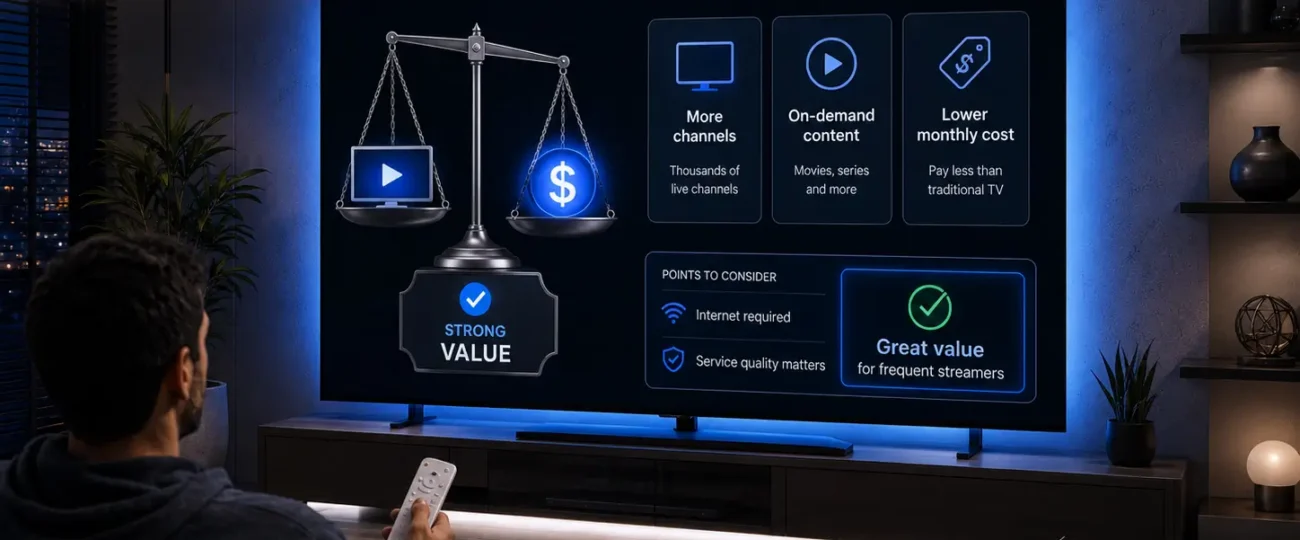
Yes, IPTV is worth it for most people who want a flexible, lower-cost way to watch live TV and on-demand content, as long as you have a stable internet connection and choose a reliable, licensed IPTV Provider. Compared with cable, it delivers significantly more channels, lower monthly costs, better picture quality, and multi-device viewing with no long-term contracts; the two things that decide your experience are both within your control.
A trusted provider for IPTV in Canada like Mode IPTV gives you access to over 15,000 live channels and 60,000+ movies and series in 4K quality for a fraction of what a basic cable package costs. This guide weighs the real value: the technology, the costs, the benefits, the honest trade-offs, how IPTV compares to cable and satellite, and who it suits best; so you can decide whether it’s the right choice for your home.
IPTV is worth it for the majority of viewers, especially those who value flexibility and want to cut their TV costs. It delivers live channels and on-demand content over your existing internet connection; no extra line to install, no bulky equipment to rent; and the value shows immediately against a traditional package: you typically pay less, watch on more devices, and aren’t locked into a multi-year contract.
It’s a natural fit for households looking to lower the TV bill, for people who watch on phones and tablets as well as the main screen, and for sports and international-content fans who want coverage that cable fragments across expensive add-ons. Whether it’s worth it for you comes down to your internet quality and the provider you pick; the rest of this guide covers both.
The two platforms deliver television in fundamentally different ways, and that difference explains almost everything else in this comparison.
Cable TV relies on a closed, dedicated coaxial or fibre network. The signal travels one way; from the provider to your TV; which provides a stable picture but is costly to maintain and leaves very little room for interactivity. Your role is limited to changing the channel.
IPTV uses internet-based protocols to deliver content over the broadband connection you already pay for. Because it’s two-way and fully digital, the service is dynamic and scalable: on-demand libraries, interactive features, and instant updates are built into the architecture rather than bolted on.
This is also why IPTV is the future-proof choice: the entire industry is converging on the model; even the big CRTC-regulated Canadian telecoms now deliver their “cable” products over internet protocols, while 5G, expanding fibre, and cloud delivery keep removing the last barriers. Choosing IPTV today means adopting the direction television is moving, not betting on a niche.
IPTV is dramatically cheaper than cable in Canada, and price is the single biggest reason Canadians are switching in record numbers. A typical cable package costs $80–$150 per month; often covering a limited channel selection, with premium add-ons billed separately. IPTV subscriptions generally range from $10 to $30 per month and include thousands of live channels plus a massive on-demand library in the base price, with no hidden fees.
| Cost Factor | Cable TV | IPTV |
| Monthly subscription | $80–$150 | $10–$30 |
| Equipment rental | $10–$25/month | $0 (use your own devices) |
| Installation fee | $50–$150 one-time | $0 (self-install in minutes) |
| Premium channels | $10–$20/month extra each | Usually included |
| Contract commitment | 12–24 months required | No contract, cancel anytime |
| Annual total cost | $1,200–$2,100+ | $120–$360 |
| Yearly savings with IPTV | — | $800–$1,700+ |
This isn’t a niche calculation; it’s a national trend. The non-profit Angus Reid Institute has tracked a steady decade-long decline in Canadians subscribing to traditional cable and satellite, with cost and value among the leading reasons for cutting the cord.
The pricing model itself is also different. Cable bundles unwanted channels into fixed packages; many IPTV providers offer flexible, à-la-carte-style plans where you pay only for the packages you actually want, and promotional pricing or quarterly/annual discounts push the effective monthly rate even lower. You still pay for internet either way; the real saving is in replacing the TV portion of your bill, and for most budgets that adds up to meaningful monthly savings.
IPTV offers vastly more content than any cable package in Canada, and it is not close. A standard Canadian cable plan includes between 100 and 300 channels, many of them filler you never watch but are forced to pay for. IPTV services routinely offer 15,000+ live channels covering every category imaginable: local Canadian channels, US networks, international programming in dozens of languages, specialty sports, and niche genres cable simply does not carry.
The bigger difference is control. Cable limits you to preset channel packages assembled by the provider; IPTV lets you handpick the content that matters to you, from mainstream hits to niche and international programming. Beyond live TV, IPTV includes on-demand libraries with tens of thousands of movies and series available anytime; content cable only offers through expensive pay-per-view or add-on packages.
Sports fans get a particular win here: IPTV’s coverage often includes leagues and events that are split across multiple expensive packages on traditional TV; or missing entirely; and you can follow a game on the main screen or a phone on the go. Live sports are the most demanding content (fast motion needs a steady, fast stream), so pair that coverage with a wired connection or strong Wi-Fi and the experience rivals or beats a traditional broadcast.
IPTV matches and often surpasses cable in picture quality, especially for 4K Ultra HD. Most Canadian cable providers still deliver the majority of channels in 720p or 1080i, with only a handful in Full HD and very few in 4K. IPTV providers offer a large number of channels in Full HD 1080p and 4K Ultra HD, delivering sharper, more vibrant images on modern televisions.
Key quality differences at a glance:
Widespread 4K UHD support on IPTV vs. mostly 720p/1080i on cable.
Cable delivers a constant signal regardless of internet; IPTV is equally stable with a connection of 25 Mbps or more.
IPTV supports Dolby Digital and surround sound on compatible apps, matching or exceeding cable.
IPTV movies and series are often in full 4K HDR; cable VOD is typically limited to HD.
Unlike satellite, neither cable nor IPTV is affected by storms.
Modern IPTV apps include built-in upscaling that improves lower-resolution streams on 4K TVs.
The only requirement on the IPTV side is a stable connection; at least 25 Mbps for Full HD and 50 Mbps for 4K, which the vast majority of Canadian internet plans already provide (run a quick speed test to confirm yours).
Where cable makes you adapt to a fixed broadcast schedule, IPTV adapts to you.
Together these turn television from a passive broadcast into a personalized, interactive experience; the core reason IPTV feels like an upgrade rather than a substitute.
Because cable is a one-way broadcast system, several capabilities are simply outside what the technology can deliver:
Stream on your Smart TV, phone, tablet, laptop, or gaming console; at home or on the go; while cable ties you to the TV with the set-top box.
Tens of thousands of movies and series at no extra cost, versus cable’s separately billed VOD and pay-per-view.
Start watching in minutes on devices you already own; cable requires a technician visit, box rental, and coaxial wiring.
Month-to-month with zero penalties, versus 12–24 month lock-ins with hefty exit fees.
Rewind live TV or watch programs from the last few days; features most basic cable plans lack without a costly PVR add-on.
Channels from dozens of countries and languages under one subscription, while cable charges premium rates for international add-ons.
The gap grows wider every year as IPTV technology continues to advance while cable’s feature set stands still.
For most households, yes; IPTV is better than cable TV on cost, content, quality, and flexibility, as the previous sections show. But two things deserve an honest look before you commit; your internet, and whether cable’s remaining strengths matter in your home:
IPTV shows its best above roughly 25 Mbps; below that, you can still watch in standard or lower-HD quality, but the smart move is to upgrade the connection first or set expectations about resolution. Also check your data situation if you’re on a capped plan.
Cable’s signal never depends on internet outages, Wi-Fi issues, or network congestion; a real consideration in rural areas where broadband is unreliable, or for viewers who specifically want a connection-independent service.
Cable is a known quantity for viewers who find streaming apps confusing to set up, and for those who only want to flip through a fixed lineup.
For the vast majority of Canadian households with a reliable 25 Mbps+ connection, however, these cases are the exception; and everywhere else, IPTV’s benefits in content, cost, flexibility, and convenience carry the decision.
IPTV generally offers better security than cable thanks to encrypted data transmission, which makes streams significantly harder to intercept. Because IPTV runs on modern software, providers can also patch vulnerabilities quickly; unlike cable’s static, hardware-bound infrastructure, where fixes require physical equipment cycles.
On the reliability side, the equation is simple: cable’s stability comes from its dedicated line, while IPTV’s stability comes from your internet connection. With a stable 25 Mbps+ connection and a reputable provider running redundant servers, IPTV reliability is effectively equivalent for daily viewing. When IPTV disappoints, the cause almost always traces to one of two things: an unstable connection, or an unreliable provider.
That makes provider choice the single biggest factor in long-term satisfaction; a reputable, licensed service determines stream stability, support quality, and your safety, and avoids the instability that comes with unauthorized operations. Protect the experience the same way you’d protect any online account: choose a provider with secure payment processing, use a unique password, and keep your apps updated.
If you’re convinced, don’t cancel cable the same day. The smart transition looks like this:
For most viewers, yes. You get live channels and on-demand content over the internet you already pay for, usually for less than a traditional package, watchable across several devices with no long contract. The value depends on the two things you control: a stable connection and a reputable, licensed provider.
For many people, yes; if flexibility, multi-device viewing, lower cost, and on-demand content matter most, IPTV comes out ahead. Cable’s one remaining advantage is a connection that never depends on your internet quality. For households with solid internet, the flexibility and savings typically make IPTV the more attractive option overall.
Yes. For the vast majority of Canadian households with a stable connection of 25 Mbps or more, IPTV fully replaces cable with more channels, more content, and a much lower price.
Not ultra-fast; but stable. Aim for roughly 25 Mbps for smooth HD and 50 Mbps for 4K, with headroom if several people stream at once. Stability matters as much as raw speed; a steady connection prevents the buffering that frustrates people most.
Especially so; broad coverage of leagues and events that traditional TV splits across packages, watchable on any screen. Live sports are data-heavy, so a wired connection or strong Wi-Fi keeps fast action sharp.
Very; with the right foundations. A reputable, licensed service on stable servers plus a solid home connection (ideally wired for the main TV) delivers consistent daily viewing. Problems almost always trace to an overloaded connection or an unauthorized provider, not the technology.
Yes. Free or unauthorized sources tend to be unstable, unsupported, and risky for your devices and personal data. A paid, licensed service delivers reliable streams, better quality, real support, and peace of mind; factor in the hours saved from buffering and broken links, and the modest monthly cost beats “free” easily.
Households looking to lower their TV bill, people who watch on phones and tablets as well as the main screen, and sports or international-content fans who want coverage cable fragments across add-ons. It’s less ideal only for homes with very slow, unreliable internet.
No. Reputable IPTV providers include all major Canadian local and regional channels in their standard packages. Verify your specific channels during a free trial.
Yes. Smart TVs run IPTV apps directly, and any regular TV works with an inexpensive streaming device or set-top box connected via HDMI.
No; it’s easier. Cable requires a technician visit; IPTV setup takes less than 10 minutes: download an app, enter your credentials, and start watching.
On average, Canadian households save between $800 and $1,700 per year by replacing cable with IPTV.
Yes, and it’s the recommended approach. Keep both services running during a free trial so you can compare quality, channels, and reliability before making the final switch.
Yes; most cable providers require rented set-top boxes and PVR units back. Check your provider’s policy to avoid equipment charges on your final bill.
IPTV generally offers better security thanks to encrypted transmission, and providers patch vulnerabilities quickly compared to cable’s static infrastructure.
Yes; IPTV technology is fully legal in Canada. Legality depends on the provider and how content is sourced under the Canadian Copyright Act, so always choose a reputable provider that operates transparently with clear terms of service.
So, is IPTV worth it? For most Canadian households, unambiguously yes; more channels, a massive included on-demand library, better 4K picture quality, watch-anywhere flexibility, and savings of $800–$1,700 a year, all without contracts, equipment rentals, or technician visits. The two things that decide your experience are within your control: a stable internet connection and a reliable, licensed provider. Cable’s remaining strengths; a dedicated signal and familiarity; matter mainly in rural areas with weak internet or for viewers who prefer a fixed lineup, and the technology trend settles the rest: television is converging on internet delivery, and IPTV is simply ahead of the curve. The practical path is low-risk; test a reputable provider through a free trial while your cable is still active, verify your local channels and peak-hour stability, and make the switch only once IPTV has proven itself on your own screen and connection. If your internet is very slow, upgrade it first; for everyone else, a trustworthy IPTV service is a genuinely worthwhile way to watch, and an easy one to feel good about.

Premium IPTV subscription built for Canadian viewers