

 Written by Rana
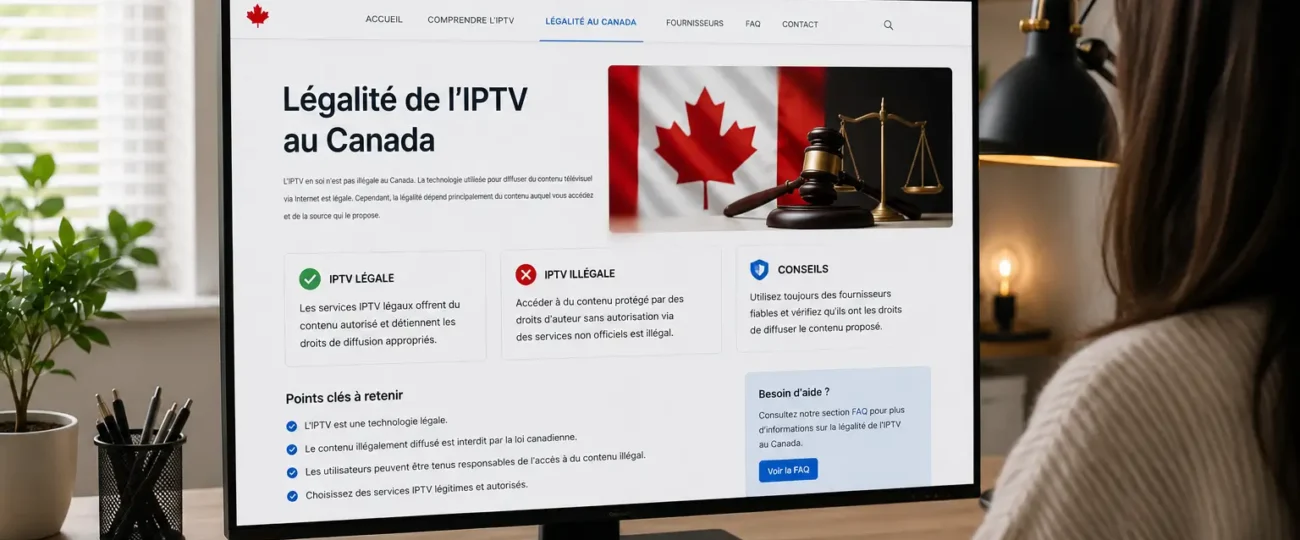
IPTV is fully legal in Canada when you use a licensed provider that pays proper broadcast rights for the content it streams. The technology itself, Internet Protocol Television, is a legitimate way to deliver TV content over the internet, used by major Canadian telecom providers and independent services alike.
Choosing a transparent, licensed IPTV provider with verifiable business operations and clear payment methods is the safest way to enjoy IPTV without legal risk.
If you’ve been wondering whether watching IPTV is legal in Canada, you’re not alone, it’s one of the most common questions among Canadian streamers. The answer depends entirely on the provider you choose, not the technology itself.
This guide breaks down exactly what’s legal, what’s not, and how to identify the difference before you subscribe.
Yes, IPTV technology itself is completely legal in Canada and widely used by both major telecom companies and independent streaming providers. IPTV simply refers to delivering television content over an internet connection instead of traditional cable or satellite signals. The legality issue isn’t with the technology, it’s with the source of the content being streamed.
According to Michael Geist, Canada Research Chair in Internet and E-commerce Law at the University of Ottawa, Canadian copyright law specifically addresses unauthorized distribution rather than the streaming technology itself. So watching IPTV through a licensed provider is legally identical to watching a regular TV broadcast, with no risk to the viewer.
A legal IPTV service is one that holds proper broadcast licenses for the channels and content it distributes to subscribers. Here’s a breakdown of how legal vs. illegal services typically compare:
| Feature | Legal IPTV Service | Illegal IPTV Service |
| Broadcast licensing | Properly licensed | Unauthorized rebroadcast |
| Business transparency | Real address, support, contact | Anonymous operators |
| Payment methods | Credit card, PayPal | Crypto, gift cards only |
| Free trial available | Almost always | Rarely |
| Server stability | Stable, redundant | Frequent disappearances |
| Customer support | Active 24/7 | Silent or non-existent |
If a service ticks the right column more than the left, walk away. The signals are usually visible from the homepage alone.
Using unlicensed IPTV services carries real legal, financial, and security risks for Canadian users. The Copyright Act applies to consumption, not just distribution, meaning users who knowingly access pirated streams can face legal exposure, though the focus of enforcement has historically been on operators and resellers rather than viewers.
Beyond legality, unlicensed services frequently install malware through required APK files, expose payment information through unverified gateways, and disappear without warning when authorities seize their servers.
According to CIPPIC, the University of Ottawa’s clinic specializing in internet law and consumer protection, Canada’s copyright framework has been actively enforced against unlicensed streaming operators in recent years.
Yes, Canadian authorities have significantly increased enforcement against illegal IPTV operators since 2019. Federal Court orders have required major Canadian ISPs to block access to unauthorized streaming networks at the network level, and dynamic blocking orders introduced in 2022 allow rights holders to update blocked IP addresses in real time without returning to court.
These enforcement actions have shut down dozens of unlicensed services nationwide, often without warning to subscribers. The result for users is straightforward: a service that worked yesterday may be inaccessible today, with no refund and no recourse, which is why choosing a properly licensed provider matters more than ever in 2026.
Individual Canadian viewers are rarely prosecuted for watching IPTV, but the legal and security risks vary depending on the service you use. Enforcement authorities have consistently focused on the operators and resellers of unlicensed services, not on individual subscribers. However, that doesn’t mean using illegal IPTV is risk-free for users. Here are the main concerns:
These practical risks are far more likely to affect you than direct legal action, but they’re real, and they’re avoidable.
Choosing a legal IPTV provider comes down to verifying five concrete signals before subscribing. Look for transparent business information (real address, support email, company name), licensed content with no claims of “lifetime” packages for absurdly low prices, verified payment methods like credit cards and PayPal rather than crypto-only options, an active customer support channel that responds within hours, and a working free trial that lets you test the service before paying.
A reliable IPTV provider like IPTV Canada with proper licensing, stable infrastructure, and a transparent track record offers everything cable used to deliver, without the legal gray zone or the disappearing-server risk.
IPTV is legal in Canada when you use it correctly, through a licensed provider that respects copyright law and operates transparently. The technology itself is legitimate and widely used, but the streaming landscape includes a real share of unlicensed services that put users at legal, financial, and security risk. The difference between safe and risky comes down to provider choice, not the technology you’re using.
The smartest approach is straightforward: verify business transparency, check for licensing signals, prioritize providers with free trials and proper customer support, and avoid anything that promises “lifetime” or unrealistically cheap deals.
A legitimate provider gives you the same access to entertainment without the gray-zone risks, and that peace of mind is worth far more than a few dollars in monthly savings.
Watching IPTV through a licensed provider is fully legal. Watching unlicensed streams that rebroadcast premium content without authorization falls under copyright infringement.
Individual viewers are rarely fined or prosecuted in Canada — enforcement focuses on operators and resellers. The bigger risk is losing access and exposing your payment data when an unlicensed service shuts down.
Check for transparent business information, licensed content, verified payment methods, and a free trial. If those are missing, the service is almost certainly unlicensed.
Yes, but only unlicensed ones. Canadian courts have ordered ISPs to block specific pirate IPTV networks. Legal IPTV providers continue operating without any restrictions.
A VPN doesn’t change the legality of the content. Watching licensed IPTV is legal whether you use a VPN or not, and watching unlicensed streams remains illegal even with a VPN.
You lose access immediately, with no refund. Your payment data may also be exposed if the provider’s servers are seized.
Yes. Licensed IPTV operates under the same broadcast licensing principles as cable TV. The only difference is the delivery method — internet protocol instead of coaxial cable.
The Canadian Copyright Act is the primary law that governs IPTV legality. It defines what counts as authorized vs unauthorized rebroadcasting of copyrighted content. Section 27 of the Act covers infringement directly, while Federal Court rulings since 2019 have empowered rights holders to obtain dynamic blocking orders against unlicensed streaming services.
Only those who resell content from properly licensed providers. Reselling unlicensed IPTV streams — even unknowingly — is treated as copyright infringement under Canadian law, with fines up to $20,000 CAD per infringement. Always verify the provider’s licensing before becoming a reseller.
This depends on your provider’s terms of service. Most legitimate IPTV providers allow 2 to 5 simultaneous connections for household members, but sharing credentials beyond your immediate household typically violates the contract — and may also violate copyright law if the shared access enables wider distribution.
Yes. The Canadian Anti-Fraud Centre accepts reports of online scams, including fraudulent IPTV services. While they can’t directly recover your money, your report contributes to law enforcement investigations and helps protect other Canadians from the same operations.
A licensed provider pays content rights holders for redistribution, displays clear corporate information, accepts mainstream payment methods, and operates as a registered Canadian or international business. An unlicensed provider rebroadcasts streams without permission, hides corporate identity, and often offers prices far below sustainable market rates.

Premium IPTV subscription built for Canadian viewers