

 Written by Rana
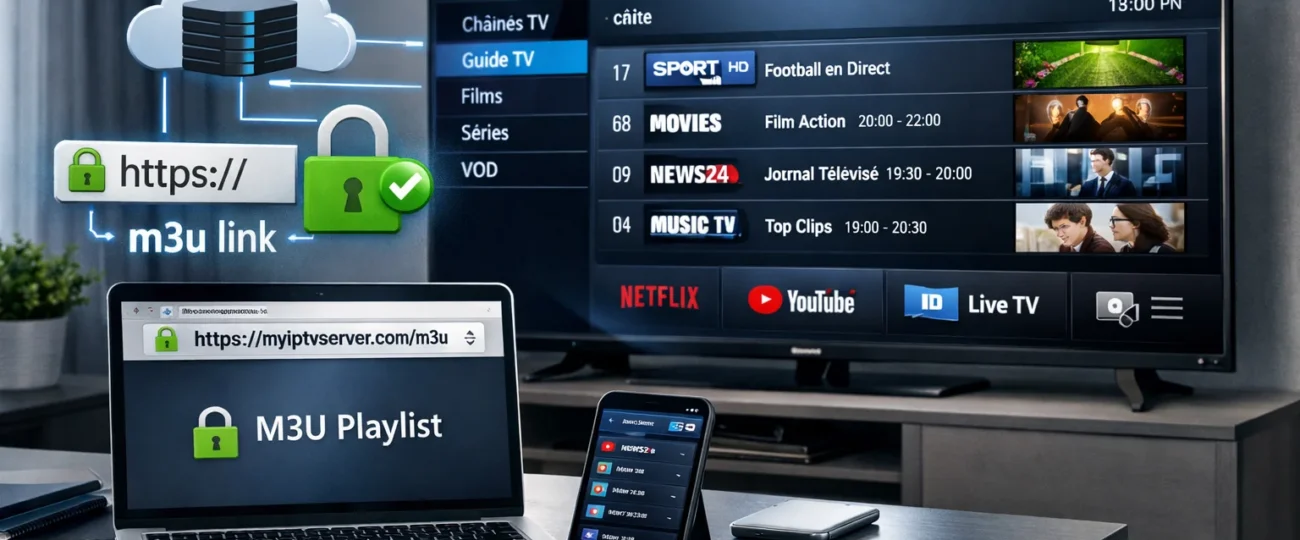
You get a URL for IPTV from a real IPTV provider account: after subscribing, the provider gives you a personal M3U playlist link plus a TV guide (EPG) link, both tied to your username, device limits, and an expiration date — usually found in your account dashboard. If your provider uses Xtream Codes, you don’t get one long link; you enter three things instead: server address, username, and password.
Under the hood, an IPTV URL is a standardized link that directs your media player to a streaming source, functioning as both an access credential and a directory pointer. This guide explains what these URLs are, the difference between M3U, M3U8, and Xtream Codes, where legitimate URLs come from, how to load them into every popular app, and how to spot the unsafe sources you should never touch.
When you input an IPTV URL into compatible software like TiviMate or VLC, the player parses the response to extract channel streams, metadata, and EPG data — all delivered over standard HTTP/HTTPS.
Either way, the URL is your key and your map at once — it proves your access and tells your device exactly where to find and decode the right video streams. That’s why the link is personal, why it expires with your subscription, and why guarding it matters.
The distinction centres on encoding and stream-protocol compatibility:
One rule worth remembering: changing a file extension doesn’t convert the underlying stream. The playlist only points to endpoints — the actual content must match the referenced format. In practice, use whichever your provider supplies and don’t rename anything.
Beyond the technical format, the two systems handle your access and updates differently:
Most quality providers supply both; use Xtream Codes where your app supports it and keep the M3U link as the universal fallback.
An “IPTV URL” is not one standard public link — it’s generated by systems that control who can watch, on which device, and for how long:
| Source Type | What It Is | How It Works | Reliability |
| Official IPTV services | Legal platforms with user accounts | Create personal M3U and EPG links tied to your account | High and stable |
| TV channels & streaming networks | Broadcasters and media companies | Protected streaming links for their own apps and approved partners | High but restricted |
| Unofficial restreaming services | Services repackaging many channels | Bundle channels into one big playlist link, often without rights | Unstable and risky |
On the free side, open-source repositories host curated public M3U playlists, and some legal ad-supported platforms distribute public M3U8 URLs — legitimate but limited, with mostly niche channels and no support. Paid providers deliver your URL through private links or API credentials linked to your subscription. The pattern is consistent: the more official the source, the more stable the URL.
If you use a legal IPTV service, your own account is the source of truth — links there are generated per user (sometimes per device), which makes them the most reliable:
Can’t find a dashboard? Your welcome email contains the same credentials — and your provider’s help pages document the exact link format they use.
The stream URL is only half the setup. The EPG URL — usually XMLTV-formatted guide data — synchronizes channel schedules with your playlist, turning a raw channel list into a real TV guide with now-playing and upcoming-program information.
Providers typically supply it alongside the playlist link; some public repositories offer guide data too. Paste both URLs into your app’s settings (playlist in the playlist field, EPG in the EPG/XMLTV field), set the guide to refresh every 12–24 hours, and apply a time-shift offset if listings run a few hours off your Canadian time zone.
Same goal everywhere — let the app load channels and guide data, then refresh them automatically:
Enter details carefully — copy-paste, never retype — and keep a stable 20+ Mbps connection for HD streams.
Rule out configuration errors before assuming the provider is down:
A URL that works today isn’t necessarily safe. Watch for these danger signs around the link, the website, and the login method:
These match the broader fraud markers across the IPTV world: no traceable business, no refund policy, untraceable payments. A URL from a source with any of these signs isn’t a bargain — it’s the bait.
Your IPTV URL is a credential — treat it like a password:
A protocol-compliant address — typically ending in .m3u or .m3u8, or an Xtream Codes server endpoint — that your player uses to authenticate and fetch streaming content, channel metadata, and guide data over HTTP/HTTPS.
Load it into a compatible player (Smarters, TiviMate, VLC, Kodi), organize the imported channels into favourites and groups, and update the credentials whenever your subscription renews or your provider rotates the link.
A portal URL points MAG-style boxes and portal-based apps to the provider’s server interface, usually authenticating by MAC address or credentials rather than a playlist file. If your device asks for a “portal,” your provider has a specific URL for it — use that, not your M3U link.
Technically: provision a server with adequate bandwidth, generate an M3U file with #EXTINF metadata and direct stream URLs, and host it on an HTTP-accessible endpoint. Practically, this only applies to your own legally-owned content — for watching TV, a provider-issued URL is the answer.
Anywhere from weekly to monthly with stable providers — tied to subscription cycles, load-balancing, and anti-leech controls — while unstable sources can die daily. Never assume a link is permanent; your account dashboard always has the current one.
Only within your plan’s connection limit — most accounts allow 1 to 3 simultaneous streams unless you’ve paid for more. Exceeding the limit triggers throttling, token invalidation, or session cut-offs.
Usually not reliably. Some models can open a stream in the web browser, but codec, DRM, and playlist-format support is limited — install an IPTV app from your TV’s store for proper playback.
It can, both ways: a VPN can bypass ISP throttling and geo-blocks, but it adds latency, can reduce throughput, and shared VPN IPs occasionally get flagged by servers. Use a quality VPN only when you have a specific reason, and test speeds with it on.
The answer to “where can I get a URL for IPTV” is refreshingly simple: from your own account with a legitimate provider — the dashboard or welcome email holds your personal M3U playlist link (or Xtream Codes trio) and the EPG URL that completes the setup. Everything else in this guide is about using that link well: knowing M3U from M3U8 so formats never trip you up, pasting credentials precisely into Smarters, TiviMate, VLC, or Kodi, testing the URL in a browser before blaming your app, and backing up your settings in encrypted form. Treat the URL as the credential it is — private, expiring, and rotated by design — and steer clear of the anonymous playlists, HTTP-only portals, and Telegram-bot logins where “free” URLs live. One reliable link from one reliable provider beats a folder of dead playlists every time.
How to Fix IPTV Buffering on Any Device
How to Get an IPTV Subscription
How to Login to IPTV Smarters Player
How to Change the URL on an IPTV Box

Premium IPTV subscription built for Canadian viewers